When people talk about Cap Go Meh in Indonesia, one place almost always comes to mind: Singkawang. Located in West Kalimantan, this city has become synonymous with one of the most culturally significant celebrations in the Chinese New Year cycle. More than a festival, Cap Go Meh in Singkawang represents identity, resilience, cultural coexistence, and deep community pride.
While Imlek marks the beginning of the Chinese New Year, Cap Go Meh marks its closing, the fifteenth day that completes the celebration cycle. Understanding Singkawang means understanding this distinction: Imlek opens the year with intention and preparation, while Cap Go Meh brings closure through ritual, gratitude, and collective expression.
Also read: 5 Best Destinations to Experience Imlek in Indonesia
cap go meh or imlek: why singkawang is closely associated with cap go meh
Imlek and Cap Go Meh are often mentioned together, but they serve different roles. Imlek is the Chinese New Year itself, while Cap Go Meh signifies the final day of the celebration period. In many places, Cap Go Meh is modestly observed. In Singkawang, however, it has become a major cultural moment.
Singkawang’s strong association with Cap Go Meh comes from its long-established Chinese community, particularly those of Hakka descent. Over generations, Cap Go Meh evolved into a public expression of gratitude, protection, and cultural continuity, not only for the Chinese community, but for the city as a whole.
This is why Singkawang is often highlighted in discussions about Imlek destinations. It’s because the city stands out as the place where the Chinese New Year cycle reaches its most powerful conclusion.
the history of singkawang’s chinese community
Singkawang’s cultural landscape cannot be separated from its history. Chinese migration to West Kalimantan dates back centuries, driven largely by trade and mining activities. Over time, Chinese settlers built families, communities, temples, and traditions that became deeply interwoven with local life.
Rather than existing in isolation, these traditions developed alongside Dayak, Malay, and other local cultures. This long history of coexistence shaped Singkawang into a city where cultural expression is not hidden, but lived openly and respectfully.
Today, Singkawang is often referred to as one of Indonesia’s most tolerant cities, a reputation reflected in how Cap Go Meh is celebrated collectively, not exclusively.
the tatung tradition: spirituality, ritual, and meaning
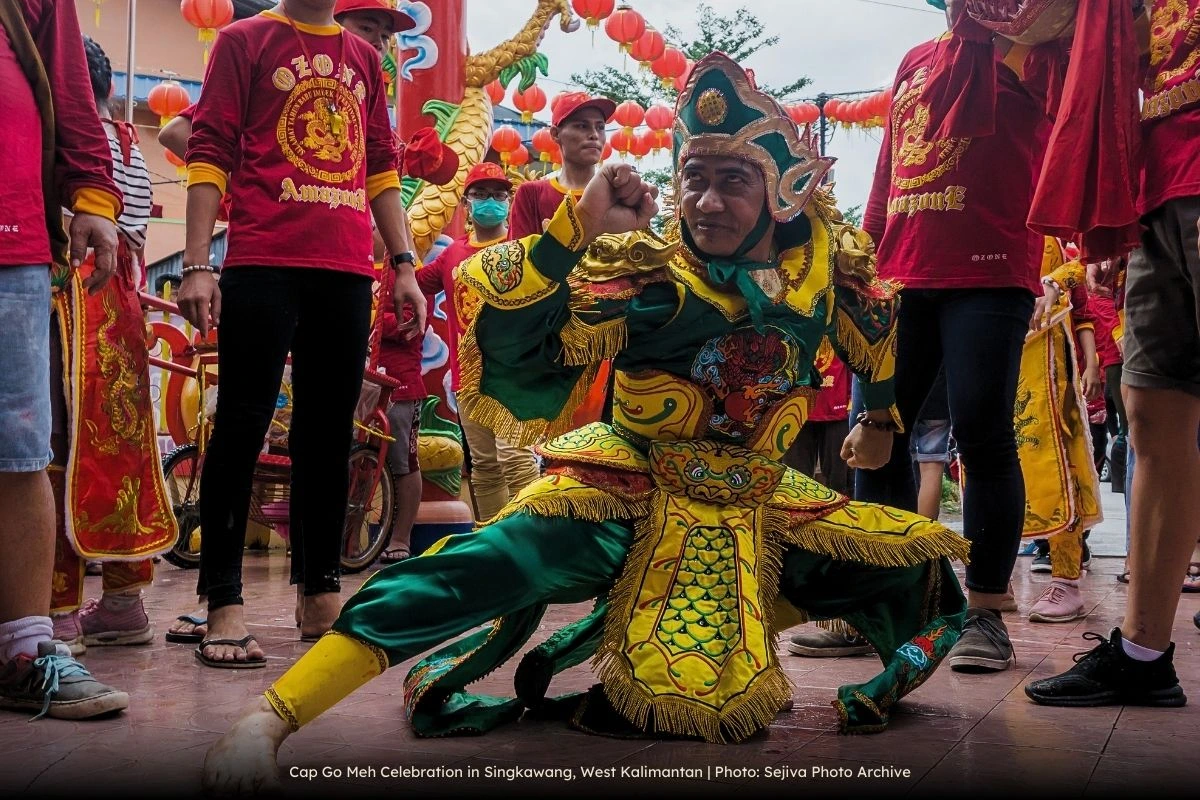
At the heart of Singkawang’s Cap Go Meh celebration is the Tatung tradition. Tatung are spiritual mediums believed to be protected by ancestral spirits or deities. During the Cap Go Meh procession, Tatung performs acts of endurance such as walking barefoot, carrying sharp objects, or piercing their bodies, not as spectacle, but as ritual.
For the local community, Tatung rituals symbolize:
- Protection for the city and its people
- Cleansing of negative energy
- Gratitude for blessings received in the past year
These rituals are deeply sacred. While visually striking, they are not performances meant for entertainment. They are acts of faith and responsibility, carried out with preparation, discipline, and spiritual guidance.From a Travel Positive perspective, witnessing Tatung rituals requires respectful observation, understanding when to watch quietly, when to step back, and why not everything should be documented or consumed as content.

cultural coexistence and everyday tolerance
What makes Singkawang exceptional is not only the scale of Cap Go Meh, but the way it is supported across communities. Malay and Dayak residents participate by helping with logistics, crowd management, and hospitality. Local residents open their neighborhoods, streets, and public spaces for collective use.
This cooperation reflects a deeper truth: Cap Go Meh in Singkawang is not “someone else’s festival.” It is a shared cultural moment that strengthens local identity and social bonds. In a time when cultural differences are often highlighted as divisions, Singkawang shows how tradition can become a bridge rather than a boundary.
tourism, community pride, and cultural responsibility
As Singkawang’s Cap Go Meh gains national and international attention, tourism naturally follows. This brings both opportunity and responsibility.
For the local community, Cap Go Meh is a source of pride, a chance to share cultural heritage on their own terms. For visitors, it is an opportunity to learn a new culture.
Culture-led tourism in Singkawang works best when travelers:
- Learn the meaning behind rituals
- Respect sacred spaces and moments
- Support local livelihoods thoughtfully
- Prioritize presence over spectacle
This approach aligns with the #TravelPositive movement, which views travel as a way to foster understanding, dignity, and mutual respect rather than extraction.

singkawang as a destination shaped by tradition
Singkawang is not defined by Cap Go Meh alone. Outside the festival period, the city offers temples, culinary traditions, local markets, and quiet neighborhoods that reflect everyday cultural life. Yet Cap Go Meh remains the moment when all these elements come together: history, faith, community, and place, forming a powerful reminder that destinations are not built by attractions, but by living traditions.
For travelers seeking depth rather than novelty, Singkawang offers something rare: a chance to witness culture not as a product, but as a responsibility carried across generations.
Singkawang’s Cap Go Meh is not just the end of the Chinese New Year celebration, it is the culmination of preparation, belief, and collective memory. It shows how tradition can shape a destination’s identity while strengthening social harmony. Mentioning Singkawang in conversations about Imlek makes sense, but understanding why it is most iconic during Cap Go Meh allows for a deeper appreciation of its cultural role.
For those willing to approach it with humility and curiosity, Singkawang offers more than a festival. It offers a lesson in how culture lives, through people, place, and shared responsibility.